Science basics
What Are Peptides?
A clear introduction to amino acids, peptide bonds and the language of molecular science.
The building blocks
Amino acids are small molecules that form the building blocks of peptides and proteins. A peptide is a short chain of amino acids joined by peptide bonds. The order of those building blocks is called its sequence. These terms describe molecular structure, rather than a product’s quality or suitability for any particular purpose.
What is a peptide bond?
A peptide bond is the chemical connection between neighbouring amino acids in a chain. Once linked into a chain, the individual amino-acid units are often called residues. A sequence with ten residues therefore contains ten linked amino-acid units.
Peptides and proteins
Both peptides and proteins are built from amino acids. Peptides are generally shorter; proteins typically contain longer chains that fold into structures. The boundary is a convention rather than a universal rule. Chain length alone does not tell you what a molecule does.
Three terms worth knowing
- Sequence: the order of amino-acid residues.
- Structure: the arrangement of a molecule in three dimensions.
- Function: what that molecule does in a particular biological or experimental context.
Keeping those ideas separate makes scientific descriptions easier to follow. A structural description is not, by itself, evidence for a practical outcome.
Reading beyond the name
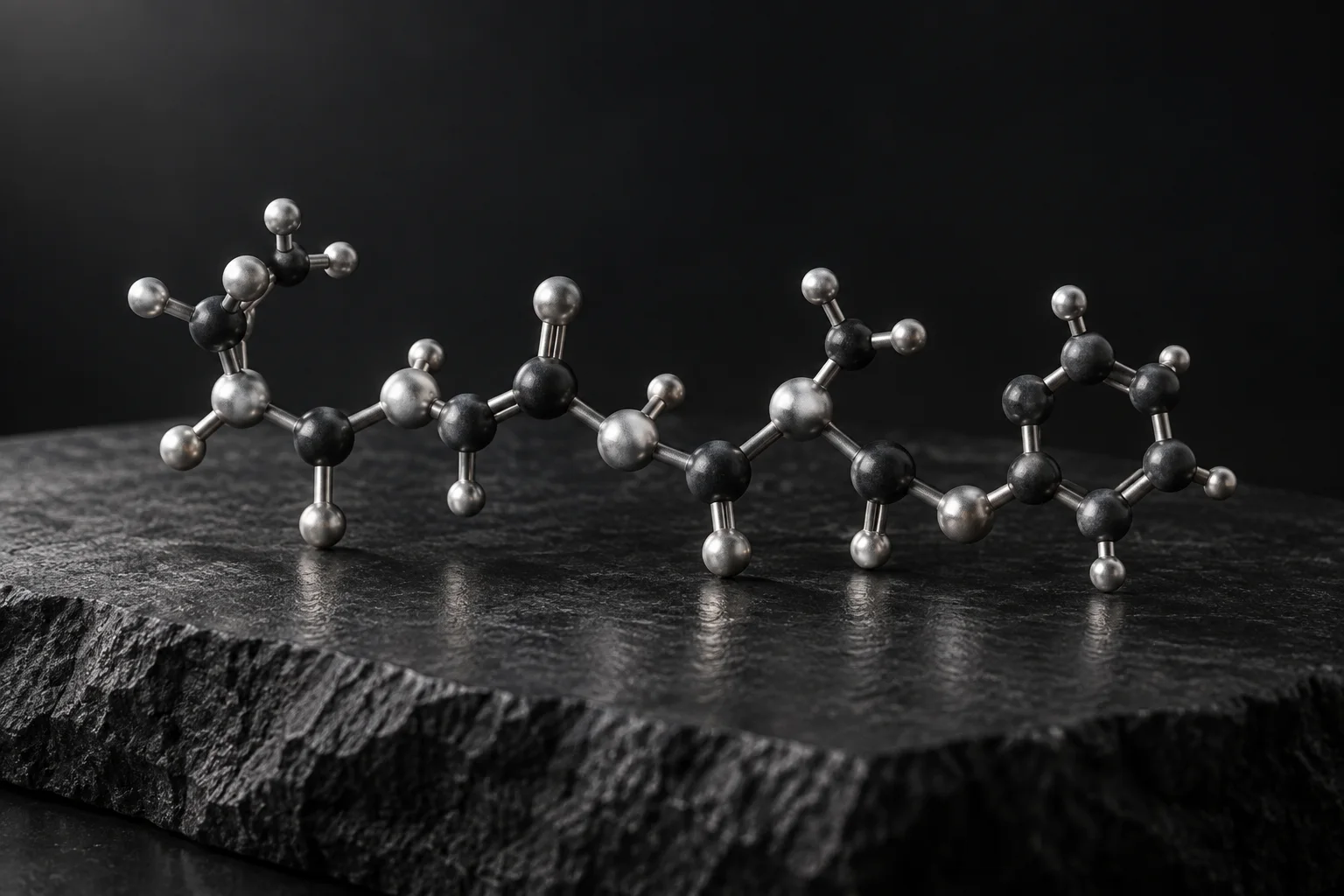
When reading an article, ask whether it is describing a molecule, an experiment or an interpretation. Look for the original source and the context of any finding. Our introduction to reading a scientific study explains how to approach those questions. The cover image is a conceptual illustration, not a structural diagram of a specific peptide.
Sources and further reading
General science education. This article does not provide instructions for preparation, administration or personal use.